
Critical notes on bamboos from Flores Island
Article Sidebar
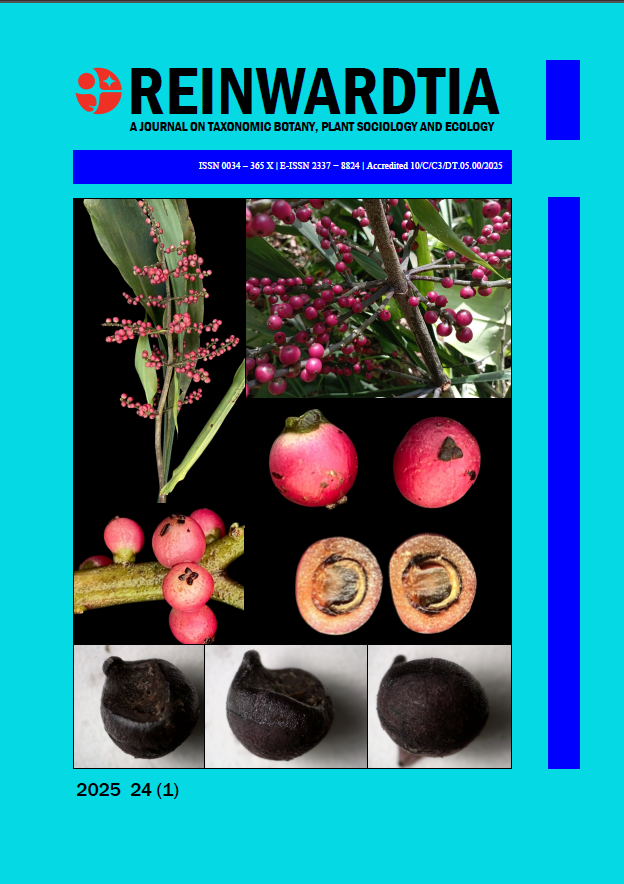
Main Article Content
Abstract
WIDJAJA, E. A., LARASATI, I. & SUKAESIH, Y. Y. 2025. Critical notes on bamboos from Flores Island. Reinwardtia 24(1): 41‒50. — Based on the results of extended field exploration, including the taxonomic study of bamboo growing in Flores, two new species, namely Dinochloa nigroviolacea and Gigantochloa kelimutuense will be described and illustrated. It was also observed that the Timorese black bamboo Gigantochloa lako, which has not been reported before from Flores, was found growing wild in the interior of Ende Regency. Furthermore, our studies indicated that Chloothamnus schmutzii should be reduced to synonymy of Chloothamnus reholttumianus, which grows wild and has spread from Ngada Regency to West Manggarai Regency; this species is also found in East Sumba and Sumbawa. The results of our observations indicate that at present there are 17 species of bamboo growing in Flores, belonging to Bambusa (4 species), Chloothamnus (1 species), Dendrocalamus (1 species), Dinochloa (2 species), Fimbribambusa (1 species), Gigantochloa (4 species), Phyllostachys (1 species), Schizostachyum (2 species), and Thyrsostachys (1 species). They can be distinguished using the key provided
Article Details

This work is licensed under a Creative Commons Attribution-ShareAlike 4.0 International License.
Reinwardtia is a peer-reviewed scientific journal committed to the open dissemination of knowledge. In alignment with the Budapest Open Access Initiative (BOAI) and the UNESCO Recommendation on Open Science (2021), Reinwardtia provides immediate, free, and unrestricted access to its published content. The journal operates in full compliance with the Directory of Open Access Journals (DOAJ) criteria and the Principles of Transparency and Best Practice in Scholarly Publishing.
- Definition of Open Access
Reinwardtia defines Open Access as the unrestricted availability of research outputs on the public internet. Users are permitted to:
- Read, download, copy, distribute, print, search, or link to the full text of articles.
- Crawl articles for indexing or utilize them for any other lawful purpose.
- Access content without financial, legal, or technical barriers, aside from those inherent in gaining internet access itself.
All articles are made openly available immediately upon publication without an embargo period, and are delivered in formats that support both reuse and machine-readability.
- Author Copyright
Authors publishing in Reinwardtia retain full copyright of their work. By submitting a manuscript, authors grant Reinwardtia a non-exclusive license to publish, distribute, and archive the article in both print and digital formats.
The official copyright notice is detailed at : https://biologyjournal.brin.go.id/index.php/reinwardtia/CopyrightNotice
- Licensing (for CC-BY-SA)
All articles published in [Journal] are licensed under the Creative Commons Attribution-ShareAlike 4.0 International License (CC BY-SA 4.0).
Reinwardtia by BRIN is licensed under a Creative Commons Attribution-ShareAlike 4.0 International License. Permissions beyond the scope of this license may be available at brin.go.id.
This license allows others to remix, adapt, and build upon the work even for commercial purposes, provided they give appropriate credit to the original author and license their new creations under identical terms. This policy ensures a vibrant ecosystem of knowledge sharing while guaranteeing that any derivative works remain open and accessible to the public under the exact same conditions.
- Article Processing Charges (APC)
Reinwardtia is a diamond open access journal, meaning that:
- No submission fees are charged.
- No article processing charges (APCs) are imposed on authors.
All publication costs are fully funded by the journal’s publisher to promote equity in scholarly communication. Author Fee Policy can also be found at: https://biologyjournal.brin.go.id/index.php/reinwardtia/authorfees
References
CAI, Z. Y., WIDJAJA, E. A., XIA, N. H. & WONG, K. M. 2024. Gigantochloa lako (Poaceae, Bambusoideae), a new combination for a horticulturally important bamboo species from Southeast Asia. Phytotaxa 663(2): 101–105. DOI: 10.11646/PHYTOTAXA.663.2.6.
CHADBURN, H. 2020a. Chloothamnus reholttumianus. The IUCN red list of threatened species 2020: e.T167852518A167853419. DOI: 10.2305/IUCN.UK.2020-3.RLTS.T167852518A167853419.en. (Accessed 25 July 2023).
CHADBURN, H. 2020b. Chloothamnus schmutzii. The IUCN red list of threatened species 2020: e.T167852532A167853424. DOI: 10.2305/IUCN.UK.2020-3.RLTS.T167852532A167853424.en. (Accessed 25 July 2023).
DAMAYANTO, I. P. G. P., ARINASA, I. B. K., TIRTA, I. G. & WIDJAJA, E. A. 2020. A new record of Chloothamnus Buse (Poaceae: Bambusoideae) from Sumbawa Island and notes on the genus in Malesia. Floribunda 6 (4): 137–132. DOI: 10.32556/floribun da.v6i4.2020.282.
DAMAYANTO, I. P. G. P., 2024. Keanekaragaman jenis bambu (Poaceae: Bambusoideae) Kepulauan Sunda Kecil. Institut Pertanian Bogor, Bogor. [PhD. Thesis].
DRANSFIELD, S. 1980. Three new Malesian species of Gramineae. Reinwardtia 9(4): 386–392.
SOENARKO, S. 1977. A new species of Nastus Nees (Gramineae) from Sumba. The Garden’s Bulletin Singapore 30: 17–19.
WIDJAJA, E. A. 1998. Bamboo diversity in Flores Island. In: SIMBOLON, H. (Ed.). Biodiversity Research Series 2: The Natural resources of Flores Island. Research and Development Center for Biology, The Indonesian Institute of Science, Bogor. Pp 38–50.
WIDJAJA, E. A., BARHIMAN S., MANEK G. & HAMZAH. 2002. Potency of bamboo at Ngada Regency, Flores: Towards a bamboo industry establishment. In: DWIANTO, W. (Ed.). Proceeding of The Fourth International Wood Science Symposium. Pp. 296–302.
WIDJAJA, E. A. & KARSONO. 2005. Keanekaragaman bambu di Pulau Sumba. Biodiversitas 6(2): 95–99.
WIDJAJA, E. A. & WONG, K. M. 2016. New combinations in Chloothamnus (Poaceae: Bambusoideae), a genus of Malesian bamboos formerly confused with Nastus. Sandakania 22: 37–40.
WIDJAJA, E. A. 2023. Fimbribambusa jokowii Widjaja (Poaceae: Bambusoideae), a new scrambling bamboo from Flores, Indonesia. Advances in Bamboo Science 4: Art. 100033. DOI: 10.1016/j.bamboo.2023.100033.