
VEGETATION ANALYSIS AND POPULATION STRUCTURE OF PLANTS AT MOUNT ENDUT FORESTED AREA, GUNUNG HALIMUN SALAK NATIONAL PARK, BANTEN, JAVA, INDONESIA
Article Sidebar
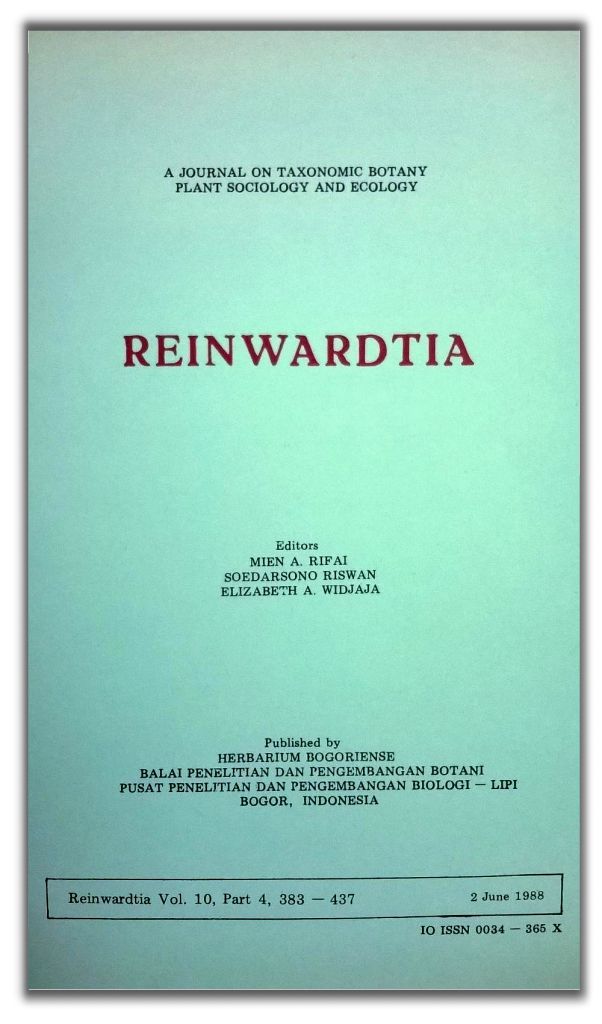
Main Article Content
Abstract
Article Details
Reinwardtia is a peer-reviewed scientific journal committed to the open dissemination of knowledge. In alignment with the Budapest Open Access Initiative (BOAI) and the UNESCO Recommendation on Open Science (2021), Reinwardtia provides immediate, free, and unrestricted access to its published content. The journal operates in full compliance with the Directory of Open Access Journals (DOAJ) criteria and the Principles of Transparency and Best Practice in Scholarly Publishing.
- Definition of Open Access
Reinwardtia defines Open Access as the unrestricted availability of research outputs on the public internet. Users are permitted to:
- Read, download, copy, distribute, print, search, or link to the full text of articles.
- Crawl articles for indexing or utilize them for any other lawful purpose.
- Access content without financial, legal, or technical barriers, aside from those inherent in gaining internet access itself.
All articles are made openly available immediately upon publication without an embargo period, and are delivered in formats that support both reuse and machine-readability.
- Author Copyright
Authors publishing in Reinwardtia retain full copyright of their work. By submitting a manuscript, authors grant Reinwardtia a non-exclusive license to publish, distribute, and archive the article in both print and digital formats.
The official copyright notice is detailed at : https://biologyjournal.brin.go.id/index.php/reinwardtia/CopyrightNotice
- Licensing (for CC-BY-SA)
All articles published in [Journal] are licensed under the Creative Commons Attribution-ShareAlike 4.0 International License (CC BY-SA 4.0).
Reinwardtia by BRIN is licensed under a Creative Commons Attribution-ShareAlike 4.0 International License. Permissions beyond the scope of this license may be available at brin.go.id.
This license allows others to remix, adapt, and build upon the work even for commercial purposes, provided they give appropriate credit to the original author and license their new creations under identical terms. This policy ensures a vibrant ecosystem of knowledge sharing while guaranteeing that any derivative works remain open and accessible to the public under the exact same conditions.
- Article Processing Charges (APC)
Reinwardtia is a diamond open access journal, meaning that:
- No submission fees are charged.
- No article processing charges (APCs) are imposed on authors.
All publication costs are fully funded by the journal’s publisher to promote equity in scholarly communication. Author Fee Policy can also be found at: https://biologyjournal.brin.go.id/index.php/reinwardtia/authorfees
References
BERLAGE, JR. H. P. 1941. Regenval in Indonesie (Rainfall in Indonesia). Verhandelingen No. 37. Drukkerij de Unie.Batavia. Pp. 8–9.
COX, G. W. 2002. General Ecology Laboratory manual. 8th Ed. McGraw-Hill, New York.
HAKIM, N. 2016. Pengelolaan Penggunaan Lahan di Kawasan Taman Nasional Gunung Halimun Salak, Kabupaten Lebak. Institut Pertanian Bogor, Bogor. [MSc. Thesis].
HARAHAP, S. A., FAIZIN, N., RACHMADI, R., EFENDI, T. & JHONI. 2005. Laporan Eksplorasi Macan (Panthera pardus Melas) di Wilayah Barat TNGHS (Gunung Barang, Gunung Endut dan Gunung Tenggek). GHSNP.MP-JICA. Bogor.
JORDAN, C. F. 1985. Nutrient Cycling in Tropical ecosystems. John Wiley & Sons, New York, Toronto, Singapore.
KAPPELLE, M. 2004. Tropical Mountain Forest. Regional Forest Type. Elsevier Ltd., Netherlands.
KITAYAMA, K. 1992. An altitudinal study of the vegetation on Mount Kinabalu, Borneo. Vegetatio 102: 149–171.
KITAYAMA, K., LEE, N. M., SHIN, L. & AIBA, I. 2000. Soil phosphorus fractional and phophorus use efficiencies of tropical Rainforests along altitudinal gradients of Mount Kinabalu, Borneo. Oecologia 123: 342–349.
KUSMANA, C. 2017. Metode Survey dan Interpretasi Data Vegetasi. IPB Press. Bogor.Pp. 33–47.
MIRMANTO, E. 2014. Natural regeneration in Cidahu resort forest area, Gunung Halimun Salak National Park, West Java. Buletin Kebun Raya 17 (2): 91–100.
MIRMANTO, E. & SIMBOLON, H. 1998. Vegetation analysis of Citorek forest, Gunung Halimun National Park. In: SIMBOLON, H., YONEDA, M. & SUGARDJITO, J. (Eds). Research and Conservation of Biodiversity in Indonesia. Vol. IV. Gunung Halimun: The Last Submontane Tropical Forest in West Java. A Joint Project among JICA, LIPI and PHPA. Bogor. Pp 41–59.
MIYAMOTO, K., SUZUKI, E., KOHYAMA, T., SEINO, T., MIRMANTO, E. & SIMBOLON, H. 2003. Habitat differentiation among tree species with small scale variation of humus depth and topography in a tropical heath forest of Central Kalimantan, Indonesia. Journal of Tropical Ecology 19: 43–54.
OGAWA, H., YODA, K., OGINO, K., SHIDEI, T., RATANAWONGSE, D. & APASUTAYA, C. 1965. Comparative ecological study on three main types of forest vegetation in Thailand. I. Structure and floristic composition. Nature and life in S. E. Asia 4: 13–48.
OHSAWA, M., NAINGGOLAN, P. H. J.,TANAKA, N. & ANWAR, C. 1985. Altitudinal zonation of forest vegetation on Mount Kerinci, Sumatera with comparisons to zonation in temperate region of East Asia. Journal of Tropical Ecology 1: 193–216.
POLOSAKAN, R. & ALHAMD, L. 2012.Keanekaragaman dan komposisi jenis pohon di hutan Pameungpeuk Taman Nasional Gunung Halimun Salak, Kabupaten Sukabumi. Jurnal Teknologi Lingkungan. Edisi Khusus ”Hari Bumi”. BPPT. Jakarta. Pp. 53–59.
PROCTOR, J., ANDERSON, J. M., CHAI, P. & VALLACK, H. W. 1983. Ecological studies in four contrasting lowland rain forests in Gunung Mulu National Park, Sarawak. I. Forest environment, structure and floristics. Journal of Ecology 71: 237–260.
RINALDI, D., HARAHAP, S. A., PRAWIRADILAGA, D. M., SAMBAS, E., WIRIADINATA, H., PURWANINGSIH, FEBRIANA, I., WIDYANINGRUM, I. K. & FAIZIN, N. 2008. Ekologi Koridor Halimun-Salak, Taman Nasional Gunung Halimun Salak. GHSNP. MP-JICA. Bogor.
SAMBAS, E. N. 2012. Klasifikasi vegetasi Gunung Endut, Taman Nasional Gunung Halimun Salak, Banten. Institut Pertanian Bogor, Bogor. [PhD. Dissertation].
SAMBAS, E. N., KUSMANA, C., PRASETYO, L. B. & PARTOMIHARDJO, T. 2011. Klasifikasi vegetasi Gunung Endut, Taman Nasional Gunung Halimun Salak, Banten. Berita Biologi 10(5) : 597–604.
SAMBAS, E. N., KUSMANA, C., PRASETYO,L. B. & PARTOMIHARDJO, T. 2013. Preferensi ekologis jenis-jenis tumbuhan dominan di Gunung Endut, Banten. Jurnal Biologi Indonesia 9(2): 209–218.
SIREGAR, M., SAMBAS, E. N., MIRMANTO,E. & RISWAN, S. 1997. Fitososiologi hutan di daerah hulu aliran Sungai Ciapus, Jawa Barat. In: WARDHANA, W. et al. (Eds.). Prosiding Seminar Biologi XIV & Kongres Nasional Biologi XI: 449–462.
[TNGHS] TAMAN NASIONAL GUNUNG HALIMUN SALAK. 2007. Rencana Pengelolaan Taman Nasional Gunung Halimun Salak Periode 2007?2026. GHSNP Management Project. Sukabumi, Jawa Barat.
VENEKLAAS, E. J. 1991. Litterfall and nutrient fluxes in two montane rain forests, Columbia. Journal of Tropical Ecology 7: 319–336.
WIHARTO, M. 2009. Klasifikasi Vegetasi Zona Sub Pegunungan Gunung Salak, Bogor, Jawa Barat. Institut Pertanian Bogor, Bogor [PhD.Dissertation].
YAMADA, I. 1975. Forest ecological studies of the montane forest of Mt. Pangrango, West Java. I. Stratification and floristic composition of the montane rain forest near Cibodas. Tonan Ajia Kenkyu (The Southeast Asian Studies) 13(3): 402–426.